
App Development
Android App Backups: Decide What Should Return on a Different Device
Review Android backup and restore rules by data purpose, with separate handling for device settings, account access, unsent drafts, and recovery testing on a new…

App Development
Design Android cache storage around recoverable data, account boundaries, predictable cleanup, and clear recovery when temporary files disappear.
LET’S BUILD SOMETHING USEFUL
Talk to ATARAXY DEVELOPERS (SMC-PRIVATE) LIMITED about your website, app, or custom software.
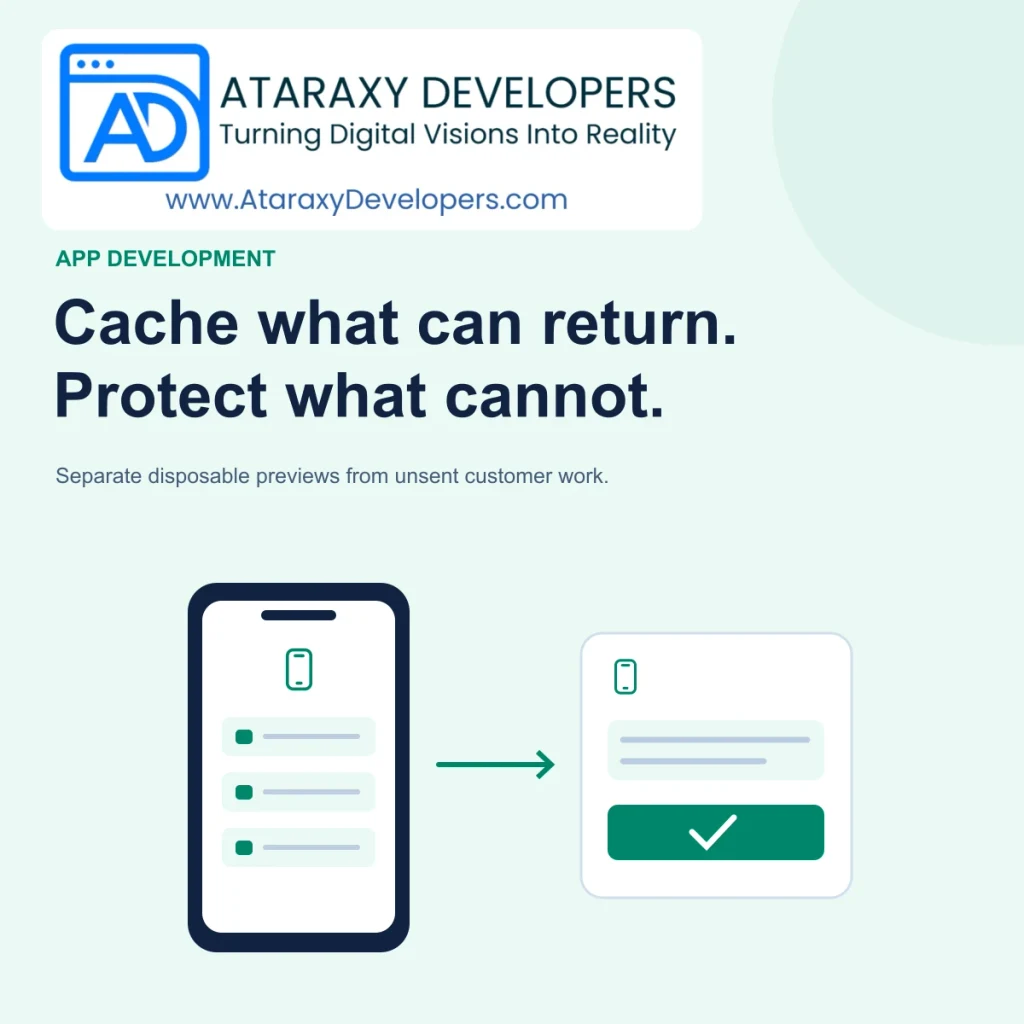
An Android app should be able to lose a cached preview without losing the customer’s work. That distinction sounds simple until an unsent attachment, a generated report, and a downloaded thumbnail all share one temporary directory. A cleanup routine removes old files, and the app can no longer explain which missing items can be recreated. Cache design begins with the meaning of each file, not with its extension or folder name.
Consider a hypothetical inspection app. It displays downloaded reference images, creates smaller previews of photos, and holds notes that have not yet reached the server. The reference image and preview may be replaceable. The only copy of an inspector’s new evidence is not. Write down the recovery source for every file class before deciding that it belongs in a cache.
Use a small storage inventory with the file’s purpose, account owner, recovery source, and removal condition. A thumbnail can be recreated from an original image; a reference document can be downloaded again if the user still has access; an unfinished export can be regenerated from a saved report definition. An unsent photograph may have no equivalent recovery source and needs more durable handling.
The Android app-specific storage guidance distinguishes persistent files from cache files. It also explains that Android may remove internal cache files when storage is low, that the app should check existence before reading, and that the app remains responsible for its own cleanup. Build your product behavior around possible cache loss instead of treating deletion as an exceptional corruption event.
A cache entry should belong to a known account or an explicitly public resource class. Include the account context in lookup and cleanup logic, and avoid deriving a filename only from a human-readable document title. Two customers can upload files with the same title. A reused filename should not cause one customer’s preview to appear in another customer’s session after account switching.
Store enough metadata to confirm that a candidate file matches the current resource version and permitted audience. The metadata can include an opaque resource identifier, version marker, generation parameters, and creation time. Do not place unnecessary customer names or secrets in filenames that may appear in diagnostics. Recheck authorization when retrieving the source; a previously cached copy does not establish continuing permission to access the content.
When a file is missing, choose a recovery action appropriate to its purpose. A thumbnail may display a placeholder while regeneration runs. A reference document may offer a download action. A file needed for a current task may require a clear waiting state. Avoid showing the same generic error for all three because their consequences and available next steps differ.
Prevent several screens from independently rebuilding the same expensive entry at once. Coordinate regeneration by cache key and let interested screens observe the same operation. If regeneration fails, keep that failure distinct from a missing original. The inspection example should say that a preview could not be created when the original is intact; it should not imply that the inspector’s evidence has disappeared.
Design writes so a reader does not mistake a partly generated file for a usable cache entry. One approach is to write to a separate temporary location, finish and close the output, then make the finished entry available through the cache index. Validate the publication behavior on the filesystem and storage APIs you actually use rather than assuming every move has identical guarantees.
Record generation failures without registering the incomplete file as ready. Clean up abandoned temporary outputs through a bounded maintenance process. If the application stops during generation, the next launch should be able to distinguish an unfinished attempt from a valid entry. Test this by interrupting a large preview build and then opening the corresponding record after the app restarts.
Set a practical budget for each cache class and decide how entries become candidates for removal. Recently used references, large disposable previews, and temporary export files may deserve different treatment. Avoid a single rule that removes every file older than a fixed time while an upload is still reading one of them. Coordinate active readers and cleanup through the same storage component.
Cleanup should be observable without exposing private content. Useful records include the cache class, approximate bytes removed, reason, and whether the operation encountered a file in use. Keep maintenance bounded so opening the app does not begin with a long synchronous directory scan. Review behavior when storage is already nearly full, since writing a fresh replacement may fail before the old entry can be swapped out.
If the interface promises that a document is available offline, define the storage and verification needed to support that promise. A file kept only as disposable cache data does not deserve the same label as a deliberately retained offline copy. Offer a way to inspect offline items and remove them intentionally, with an explanation of whether the source remains available online.
For unsent inspection work, show a durable queue with the original item, its upload status, and a recovery action. A preview can be absent while the upload remains valid. Conversely, a visible preview is not proof that the original exists or that the server received it. Test each combination so the interface does not infer successful synchronization from the presence of a local image.
Define what sign-out removes immediately and what must remain until an authorized recovery decision is made. A customer-facing promise about clearing account data should be backed by a specific storage inventory. Unsent work needs a deliberate policy before sign-out, such as a warning and a supported completion or discard route. Do not silently preserve private files merely because their cache keys are difficult to enumerate.
Application upgrades can also change how cached data is interpreted. Version the cache format or invalidate incompatible entries so old bytes are not read using new assumptions. Android’s app-specific storage documentation notes that uninstalling removes those files; explain any product retention promise through the storage actually chosen. A restored account session should verify source access and rebuild disposable assets rather than trusting an old preview as an authoritative record.
Create tests that remove a cached file between lookup and opening, interrupt a write, switch accounts, and exhaust the available storage budget. Confirm that the original customer work remains recoverable and that the displayed status describes the actual outcome. AI can help generate a storage test matrix, but the evidence must come from running those cases against the app’s real file handling and account transitions.
Temporary storage is dependable when the app knows what it can reconstruct and what it must preserve. Classify files by recovery source, enforce account boundaries, publish only complete entries, and treat cache misses as expected behavior. Cleanup, sign-out, and offline labels should follow those same definitions. A missing preview should lead to a clear recovery step while the customer’s irreplaceable work stays protected.
LET’S BUILD SOMETHING USEFUL
Talk to ATARAXY DEVELOPERS (SMC-PRIVATE) LIMITED about your website, app, or custom software.
KEEP EXPLORING
Review Android backup and restore rules by data purpose, with separate handling for device settings, account access, unsent drafts, and recovery testing on a new…

Define sign-out and account switching across tokens, cached files, drafts, background jobs, notifications, and AI history with an explicit cleanup policy.

Design photo attachment flows with focused selection, useful previews, predictable image processing, honest upload states, and controlled AI assistance.

