
Noorani Browser
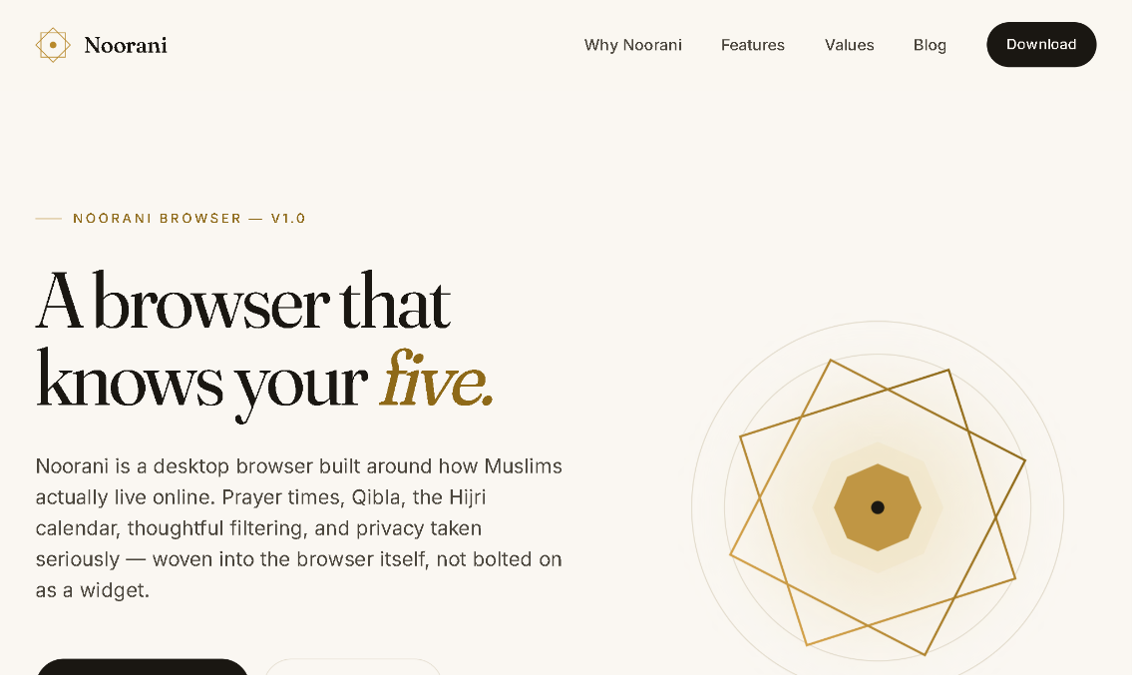
A Browser That Knows Your Five.
Project Overview
Noorani is a passion project by Waleed Naeem, founder of Ataraxy Developers, built as a desktop browser designed specifically around Muslim daily life online. Rather than requiring users to bolt on prayer-time extensions or separate Qibla apps, Noorani computes prayer times locally for the user’s coordinates, shows a built-in Qibla compass, displays a native Hijri calendar, and offers optional content filtering and a dedicated Ramadan mode. Ataraxy Developers built the entire browser from scratch, including the prayer-times engine, Qibla calculation, calendar system, tracker blocking, and Quran quick-access, and released it as free and open source software with no account requirement.
The Challenge
Most browsers treat religious or cultural needs as an afterthought, at best solved by a patchwork of third-party extensions that vary in accuracy and often come with their own trackers and permissions. For something as time-sensitive and personal as prayer times and Qibla direction, that patchwork approach creates friction and trust problems exactly where accuracy and privacy matter most.
The project also needed to hold two things in tension: being genuinely useful as a full, modern desktop browser, and staying true to a stated principle of privacy as amānah, meaning no telemetry, no ad trackers, and no data leaving the user’s device, even for a feature as personal as location-based prayer times. It needed to feel like a serious piece of software, not a novelty skin on an existing browser.
Our Approach
We built Noorani around a single idea: what if the browser already knew? Prayer times, Qibla, and the Hijri calendar were treated as core browser features from the start, computed locally rather than fetched from a server, so the product’s privacy claims and its core functionality reinforce each other instead of competing.
We supported eight prayer time calculation methods and both Hanafi and Shafi Asr methods so the browser works correctly across different regions and schools of thought, paired with a great-circle Qibla calculation for accuracy. On top of the core religious features, we built a full browsing experience: aggressive tracker blocking on by default, an optional multi-level content filter with no shaming language, and a dedicated Ramadan mode that calms the interface and adds suhoor and iftar countdowns during the month.
Core Principles
- Build it in, don’t bolt it on — prayer times, Qibla, and Hijri calendar live inside the browser itself
- Compute locally, not on a server — prayer times and location never leave the user’s device
- No telemetry, ever — no analytics server collects browsing or location data
- Open by design — the full source code is publicly available for anyone to verify
- No ads, ever — the product does not sell placements or broker user attention
- Free and frictionless — no account required, just download and go
What We Built
Prayer Times Engine
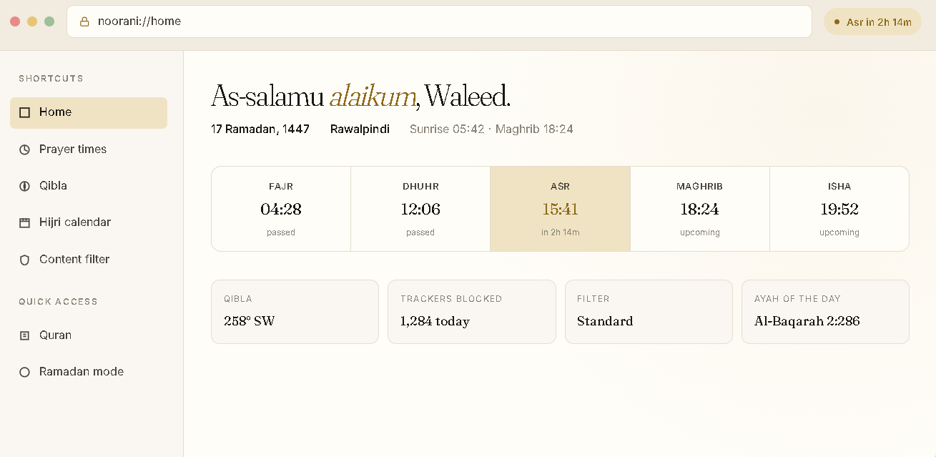
A locally computed prayer times system using astronomical algorithms, supporting eight calculation methods, Karachi, MWL, Egyptian, Umm al-Qura, ISNA, Tehran, Jafari, and Moonsighting Committee, plus both Hanafi and Shafi Asr methods and high-latitude rules.
Qibla Indicator
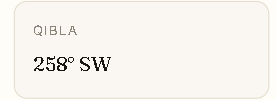
A great-circle Qibla calculation based on the user’s coordinates, showing bearing and a visual compass directly in the toolbar.
Hijri Calendar
A native Hijri calendar built into the browser, with an adjustable date offset and automatic highlighting of key Islamic dates.
Thoughtful Content Filtering
An optional content filter with three configurable sensitivity levels, designed without shaming language or alarming warnings.
Quran Quick-Access
Offline access to any surah or verse directly from the address bar, with multiple bundled translations, including Sahih International and Pickthall.
Ramadan Mode
A one-switch mode that calms the browsing interface during Ramadan, adding suhoor and iftar countdowns and stricter filtering by default.
Tracker Blocking
Aggressive, on-by-default blocking of Western ad-tech, fingerprinters, and cross-site trackers, shown live on the homepage as a running blocked-tracker count.
Ayah of the Day
An optional daily verse shown on new tabs, with translation and context, dismissible without repeated prompts.
The Work (Visual Showcase)
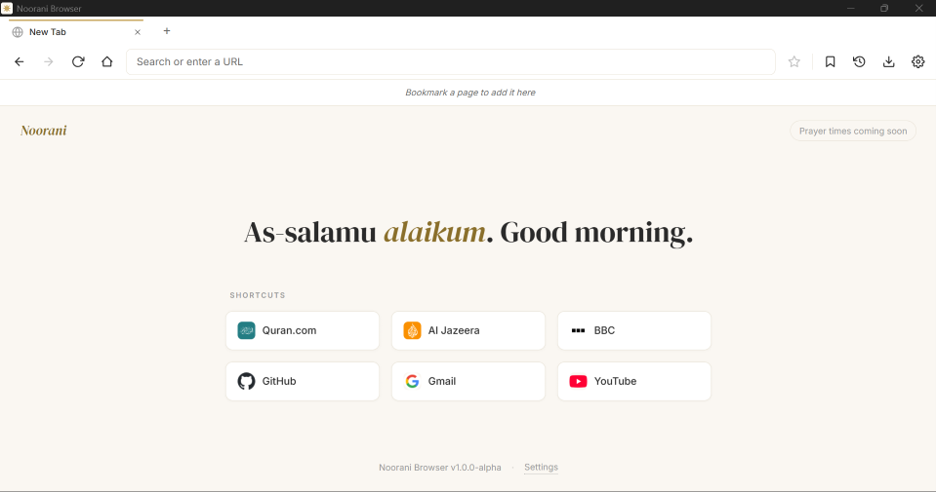
Noorani homepage / new-tab hero (desktop)
Prayer times panel with live countdown (desktop)
Qibla compass indicator (desktop)

Hijri calendar with Ramadan highlighted (desktop)
Content filter settings panel (desktop)
Quran quick-access from the address bar (desktop)
Download page across Windows, macOS, and Linux (desktop)
See It In Action
Results
Noorani launched as a self-published, open source side project rather than a client engagement, so results are described using features visible on the live website. The browser is available as a free download for Windows, macOS, and Linux, requires no account, and is currently at version 1.0.1, released in July 2026. The site states native language support for Arabic, Urdu, Bahasa Indonesia, Turkish, and Malay is planned for a future version 1.2 release.
As a portfolio piece, the project demonstrates Ataraxy’s ability to design and ship a complete, culturally specific desktop application, combining a custom prayer-times engine, Qibla calculation, calendar system, and privacy-first architecture, entirely from concept to public release.
Technology Stack
- Application: Cross-platform desktop browser (Windows, macOS, Linux)
- Prayer Engine: Custom-built local astronomical calculation engine, no server dependency
- Qibla Calculation: Custom great-circle bearing calculation
- Calendar: Native Hijri calendar via Intl.DateTimeFormat with custom offset handling
- Privacy and Security: Built-in tracker and ad blocking, no telemetry or analytics server
- Distribution: Open source release via GitHub, direct download, no app store dependency
- Support: Buy Me a Coffee for project support, GitHub for source and issue tracking
Project Timeline
| Phase | Milestone | Duration | Key Activities |
|---|---|---|---|
| Phase 1 | Concept & Core Engine | Early development | Prayer-time calculation engine, calculation method research, local computation architecture |
| Phase 2 | Qibla & Calendar Systems | Early development | Great-circle Qibla calculation, native Hijri calendar integration |
| Phase 3 | Filtering & Privacy Layer | Mid development | Content filter levels, tracker blocking, no-telemetry architecture |
| Phase 4 | Ramadan Mode & Quran Access | Mid development | Ramadan mode toggle, suhoor and iftar countdowns, offline Quran quick-access |
| Phase 5 | Release & Iteration | v1.0.1, July 2026 | Public release across Windows, macOS, and Linux, open source publication, ongoing feature roadmap including native language support |
Have a similar project in mind?
Whether you’re building a culturally specific product, a privacy-first application, or solving a real problem for a community that’s been underserved by mainstream tools, we’d love to talk about what we can build together.
AtaraxyDevelopers@gmail.com | WhatsApp: +92 312 5303767